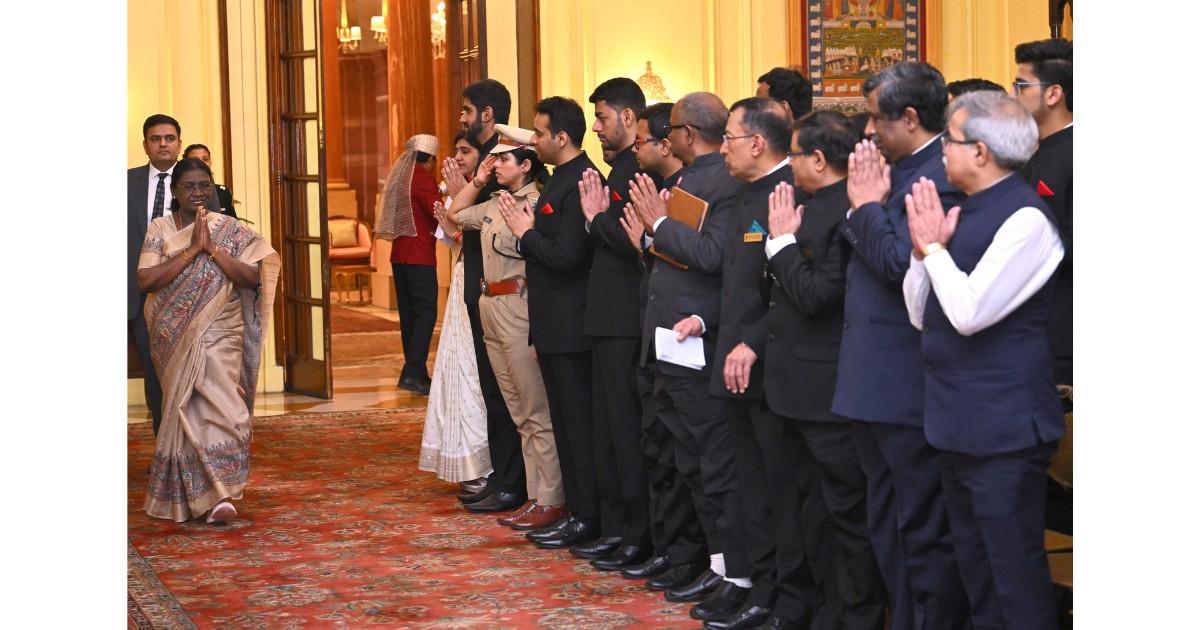
Speaking at Rashtrapati Bhavan during an interaction with probationary officers of the Indian Railways and assistant executive engineers from the Central Engineering Service (Roads), the President said transport infrastructure is not merely a means of mobility but a powerful driver of economic growth, social inclusion, and national integration.
Infrastructure as the Backbone of Growth
Addressing officers from multiple recent batches, President Murmu highlighted that India is currently advancing with the vision of a developed nation, often referred to as “Viksit Bharat.” She noted that infrastructure development plays a central role in achieving this goal.
According to her, roads and railways form the backbone of modern economies. When connectivity improves—whether through highways reaching remote regions or railway lines linking distant communities—it creates opportunities for economic activity, employment, and social mobility.
She emphasised that infrastructure is not just about physical construction but about enabling transformation in people’s lives. Improved connectivity reduces travel time, enhances access to markets, and facilitates the movement of goods and services across regions.
Impact on Economy and Society
The President elaborated on the broader economic benefits of robust infrastructure. She said that efficient transport systems help reduce logistics costs, making businesses more competitive and boosting trade. This, in turn, attracts investment and contributes to overall economic expansion.
Beyond economic gains, she highlighted the social dimension of infrastructure development. By connecting remote and underserved areas, roads and railways promote inclusion and help bridge regional disparities.
She pointed out that when a train reaches a previously isolated village or a highway links a remote district to urban centres, it opens doors to education, healthcare, and employment opportunities, thereby improving quality of life.
Message to Young Officers
President Murmu addressed the young officers as key stakeholders in India’s development journey. She noted that their roles in the Indian Railways and Central Engineering Service (Roads) place them at the forefront of nation-building.
She reminded them that their decisions and actions would directly impact millions of citizens. Therefore, she urged them to approach their responsibilities with a strong sense of purpose and commitment.
The President emphasised that success in public service should not be measured solely by numbers or statistics. Instead, she said, the real measure lies in the tangible improvements brought to people’s lives through their work.
Emphasis on Integrity and Accountability
A significant part of the President’s address focused on values such as honesty, accountability, and excellence. She urged the officers to uphold these principles in their professional conduct.
According to her, these values serve as guiding forces, especially during challenging situations and complex decision-making processes. Maintaining integrity, she said, is essential for building trust between the government and citizens.
She also described public servants as custodians of public trust, whose actions have long-term implications for governance and development.
Encouraging Innovation and Continuous Learning
President Murmu encouraged the officers to remain curious and open to learning throughout their careers. She stressed the importance of innovation in addressing emerging challenges in infrastructure development.
With rapid technological advancements, she noted, engineers and administrators must adapt to new methods and tools to improve efficiency and sustainability in projects.
She highlighted that embracing innovation can lead to better planning, execution, and maintenance of infrastructure, ultimately benefiting society at large.
Infrastructure and National Unity
The President also spoke about the role of infrastructure in strengthening national unity. By connecting diverse regions and communities, transport networks help foster a sense of belonging and shared identity.
She noted that infrastructure projects often bring together people from different backgrounds, contributing to cultural exchange and mutual understanding.
In this context, she described roads and railways as instruments that not only facilitate movement but also build connections between people and regions.
A Vision for the Future
President Murmu’s remarks align with India’s broader focus on expanding infrastructure as part of its development strategy. Over the years, significant investments have been made in highways, railways, and other transport systems to support economic growth.
The interaction with young officers reflects an effort to prepare the next generation of administrators and engineers for the challenges ahead. By emphasising values, innovation, and public service, the President outlined a roadmap for effective governance.
Role of Public Servants in Nation-Building
In her concluding remarks, the President reiterated that the officers are not merely administrators but active participants in shaping the nation’s future. She described them as carriers of progress whose work will leave a lasting impact on society.
She urged them to remain dedicated to their responsibilities and to always keep the welfare of citizens at the forefront of their efforts.
Building India Through Infrastructure and Values
President Droupadi Murmu’s address highlighted the central role of infrastructure in India’s journey toward becoming a developed nation. By linking economic growth with social inclusion and national unity, she presented a comprehensive vision of development.
Her message to young officers—focused on integrity, innovation, and public service—underscores the importance of responsible governance in achieving this vision. As India continues to invest in roads and railways, the role of such professionals will remain crucial in ensuring that development is inclusive, sustainable, and impactful.
Inputs & Images: Hindusthan Samachar
Edited By: Akshaya Polepalli
Also Read: Mohan Bhagwat Advocates Sanskrit Revival, Calls It Key to Understanding India’s Civilisational Roots